Modifications of DNA in Relation to Diabetes: Identification of Carboxymethyl-2’-Deoxyadenosine From Glycoxidation Reactions, Calf Thymus DNA, Human Urine, and DNA

  • Email
  • Print
Tuesday, May 10, 2011

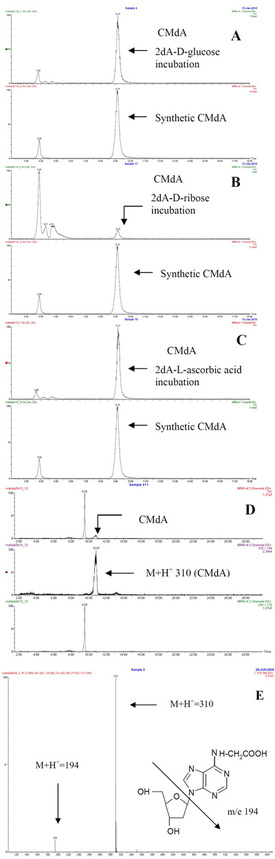
In order to prove the biological relevance of the above studies, the authors took samples of fasting human urine, adjusted to a neutral pH, and extracted the samples for CMdA following an extraction procedure similar to that used for the D-glucose incubations. Mass spectrometry confirmed the presence of CMdA with a peak of M+H+ 310 (Figure 1d). The peak was very strong, which was demonstrated by mixing experiments with synthesized CMdA sample.

Figure 4 - LC-MS spectrum using MRM spectrometric analysis of 1 M HCL hydrolyzed: a) CMdA, b) calf thymus DNA, c) human serum DNA, and d) CMdA and calf thymus DNA mixing experiment. The presence of CMA in DNA samples was followed using a M+H+ 194 peak. Peaks from the mixing experiment further confirmed the presence of CMA in both human and calf thymus DNA samples. Experiments were repeated until findings were proven conclusively.

DNA sample was hydrolyzed with 1 M HCL. This procedure cleaves off the purine bases from a DNA chain. CMdA itsef was hydrolyzed using 1 M HCL, and the sample was subjected to HPLC analysis (Figure 2b). The procedure completely hydrolyzed CMdA and CMA. An RT of 2.1 min was obtained. The identity of the peak for CMA M+H+ 194 was confirmed by electrospray MS-MS (Figure 2c and Figure 4a), including those from the synthesis reaction of CMA.

The presence of CMA in calf thymus DNA and human serum DNA samples was investigated next. Figure 4b depicts the presence of CMA in calf thymus DNA, while Figure 4c shows its presence in human DNA (LC-MS mass spectrum using MRM mode analysis), indicating that carboxymethylation of DNA nucleotide is occurring in both of these DNA molecules. The presence of CMA in calf thymus DNA was confirmed by carrying out mixing experiments with hydrolyzed CMdA sample (Figure 4d). The experiments were repeated, and modification of adenine nucleotide was observed both for calf thymus and human serum DNA samples.

Discussion

Glycoxidation and lipoperoxidation reactions produce permanent markers on biomolecules such as proteins. These markers are an important diagnostic tool to evaluate and quantify the extent of damage to the host molecules and the physiological consequences resulting from the presence of foreign materials in the molecules. Although important biomarkers of protein modification of diabetes have been widely established and used, continued investigations to detect and identify biomarkers for diseases such as cancer are still being vigorously pursued. DNA biomarkers in relation to diabetes and cancer will continue to attract numerous technologies, methodologies, and procedures to provide a better understanding of these diseases. 32Postlabeling20,21 mass spectrometry22–24 using electrochemical detection,25 fluorescence detection, and immunoassays are often used as tools in this field for quantification purposes.

Molecular damage can be largely eliminated by DNA repair processes. The extent to which DNA adducts contribute to cancer development is an important avenue of investigation. DNA adducts are an internal and individual dosimeter of exposure of an organism to genotoxic compounds and ultimately determine the biologically effective dose of a DNA damaging chemical.26 According to Ref. 18, there is a direct association between oxidative DNA damage and the complications of diabetes, as demonstrated by measuring 8-oxo-2’-deoxyguanosine in the urine and mononuclear cells of type II diabetic patients.18

Free radical modifications involving glycoxidation and lipoperoxidation reactions in proteins27,28 have direct consequences on disease processes in diabetes and atherosclerosis, for example. Although there are striking similarities in the functional natures of the amino acids present in the investigated proteins, and biomolecules such as DNA, RNA, adenosine triphosphate (ATP), and adenosine diphosphate (ADP), not much is known about the fate of these substances in diabetic and other disease processes. Experiments with 2’-deoxyadenosine and reactive carbohydrates such as D-glucose, D-ribose, and L-ascorbic acid in the present investigations indicate that glycoxidative reactions like those of proteins in diabetes do indeed occur in the studied nucleoside. CMdA has been identified by LC-MS (electrospray mass spectrometry experiments) from reactions of 2’-deoxyadenosine and D-glucose (Figure 1a) and 2’-deoxyadenosine and D-ribose (Figure 1b) incubations. CMdA showed a molecular ion (M+H+ 310) and fragment m/e of 194, matching the breakdown of the parent ion into two groups at the N–C bond between the heterocycle and the 2’-ribose part of the molecule (Figure 1e).

The identity of the CMdA compound produced from the reactions of 2’-deoxyadenosine with the carbohydrates D-glucose, D-ribose, and L-ascorbic acid was achieved by synthesizing the CMdA compound using 2’-deoxyadenosine and iodoacetic acid raw materials. The HPLC and LC-MS of the synthesized CMdA and the 2’-deoxyadenosine-carbohydrate incubated CMdA samples (Figures 1a–c, e) were identical. The presence of identified carboxymethyl derivative (CMdA) in the urine samples (Figure 1d) of fasting subjects was also investigated, identified, and confirmed by the electrospray LC-MS experiment.

These experiments proved conclusively that CMdA is produced in human systems. The results thus indicate that glycoxidative modifications involving DNA modification (possibly also in RNA, unpublished results) occur in our metabolic systems. CMdA may have arisen from glycoxidation and lipoperoxidation reactions in DNA molecules that may have been cleaved off during repair of the DNA chain. Alternatively, CMdA possibly resulted from glycoxidative modification of ADP, ATP, and AMP (adenosine monophosphate) molecules present in a living system requiring energy tranformation.

To confirm the presence of CMdA in the DNA chain itself, acid hydrolysis of both calf thymus and human serum DNA samples was carried out. Prior to that, CMdA was hydrolyzed with 1 M HCL, and the product gave a sharp peak at RT 2.1 min (Figure 1b) corresponding to CMA compared to the raw material CMdA in the HPLC peak at RT 7.1 min (Figure 1a). CMA gave a sharp peak at M+H+ 194 in LC-MS. The presence of CMA in the 1 M HCL hydrolyzed DNA (calf thymus and human samples) was investigated using LC-MS (Figure 4a–d). All of these spectra and the mixing experiments of the DNA hydrolyzed and identified CMA derivative confirmed that CMA was present in the DNA samples investigated (Figure 4d).

Independent reports from investigations at a mass spectroscopy laboratory reported a significant amount of modified CMdA in each sample. The presence of CMdA compound in investigations of glycoxidation or any other process in relation to human subjects has not been reported thus far. These results prove conclusively that glycoxidation and possibly lipoperoxidation reactions take place in human nucleic and biomolecules such as those occurring in proteins. These findings are important, since a modification will trigger removal of such a base from the DNA chain and, if unsuccessful, may lead to mutations that will affect many biological processes.

References

  1. Negre-Salvayre, A.; Coatrieux, C. et al. Advanced lipid peroxidation end products in oxidative damage to proteins. Potential role in diseases and therapeutic prospects for the inhibitors. Br. J. Pharmacol  2008, 153, 6–20.
  2. Ahmed, M.U.; Thorpe, S.R. et al. Identification of N-carboxymethyllysine as a degradation product of fructose lysine in glycated proteins. J. Biol. Chem  1986, 261, 4889–94.
  3. Januszewski, A.S.; Alderson, N.L. et al. Role of lipids in chemical modification of proteins and development of complications in diabetes. Biochem. Soc. Trans. 2003, 31, 1413–16.
  4. Rodríguez-García, J.; Requena, J.R. et al. Increased concentrations of serum pentosidine in rheumatoid arthritis. Clin. Chem. 1998, 44(2), 250–5.
  5. Ahmed, M.; Lila, Z.A. et al. Investigations on DNA/RNA Damage in Diabetes Involving Glycoxidation Reactions. In 1890 Research: Sustainable Solutions for the 21st Century; 15th Biennial Research Symposium, Mar 28–Apr 1, 2009, Atlanta, GA, p 216.
  6. Lila, Z.A.; Mahtab, R. et al. Glycoxidative Modification of DNA-RNA in Relation to Diabetes. In The 1890 Land Grant System: AED/ARD Land Grant Conference; ARD Land Grant Conference, June 8–11, 2008, Memphis, TN, p 37.
  7. Siethoff, C.; Feldmann, I. et al. Quantitative determination of DNA adducts using liquid chromatography/electrospray ionization mass spectrometry and liquid chromatography/high-resolution inductively coupled plasma mass spectrometry. J. Mass. Spectrom. 1999, 34, 421–6.
  8. Wang, H.; Cao, H. et al. Quantification of N2-carboxymethyl-2’deoxyguanosine in calf thymus DNA and cultured human kidney epithelial cells by capillary high performance liquid chromatography–tandem mass spectrometry coupled with stable isotope dilution method. Chem. Res. Toxicol. 2010, 23(1), 74–81.
  9. Wang, J.; Wang, Y. Synthesis and characterization of oligodeoxyribonucleotides containing a site-specifically incorporated N6-carboxymethyl-2’-deoxyadenosine or N4-carboxymethyl-2’-deoxycytidine. Nucleic Acids Res. 2010 [Epub ahead of print].
  10. Turrens, J.F. Mitochondrial formation of reactive oxygen species. J. Physiol. 2003, 552, 335–44.
  11. Evans, M.D.; Dizdaroglu, M. et al. Oxidative DNA damage and disease: induction, repair and significance. Mutat. Res. 2004, 567, 1–61.
  12. Hutter, E.; Skovbro, M. et al. Oxidative stress and mitochondrial impairment can be separated from lipofuscin accumulation in aged human skeletal muscle. Aging Cell2007, 6, 245–6.
  13. Maiese, K.; Morhan, S.D. et al. Oxidative stress biology and cell injury during type 1 and type 2 diabetes mellitus. Curr. Neurovasc. Res. 2007, 4, 63–71.
  14. Rachek, L.I.; Musiyenko, S.I. et al. Palmitate induced mitochondrial deoxyribonucleic acid damage and apoptosis in L6 rat skeletal muscle cells. Endocrinology  2007, 148, 293–9.
  15. Umemura, T.; Sai, K. et al. Formation of 8-hydroxydeoxyguanosine (8-OH-dG) in rat kidney DNA after intraperitoneal administration of ferric nitrilotriacetate (Fe-NTR). Carcinogenesis  1990, 11, 345–7.
  16. Dandona, P.; Thusu, K. et al. Oxidative damage to DNA in diabetes mellitus. Lancet  1996, 347, 444–5.
  17. Leinonen, J.; Lethimaki, T. et al. New biomarker evidence of oxidative DNA damage in patients with-non-insulin-dependent diabetes mellitus. FEBS. Lett. 1997, 417, 150–2.
  18. Hinokio, Y.; Sujuki, S. et al. Oxidative DNA damage in diabetes mellitus: its association with diabetic complications. Diabetologia  1999, 42, 995–8.
  19. Esaka, Y.; Inagaki, S. et al. Separation procedures capable of revealing DNA adducts. J. Chromatogr. B  2003, 797, 321–9.
  20. Randerach, K.; Reddy, M.V. et al. 32P-labeling test for DNA damage. Proc. Natl. Acad. Sci. U.S.A. 1981, 78, 6126–9.
  21. Gupta, R.C.; Reddy, M.V. et al. 32P-postlabeling analysis of non-radioactive aromatic carcinogen-DNA adducts. Carcinogenesis 1982, 3, 1081–92.
  22. Farmer, P.B.; Sweetman, G.M.A. J. Mass. Spectrom. 1995, 30, 1369.
  23. Apruzzese, W.A.; Vouros, P. Analysis of DNA adducts by capillary methods coupled to mass spectrometry: a perspective. J. Chromatogr. A 1998, 794(1–2), 97–108.
  24. Esmans, E.L.; Boroes, D. J. Chromatogr. A  1998, 794, 109.
  25. Weston, A.; Rowe, M.L. et al. Fluorescence and mass spectral evidence for the formation of benzo[a]pyrene anti-diol-epoxide-DNA and hemoglobin adducts in humans. Carcinogenesis  1989, 10(2), 251–7.
  26. Oliver, J.S. Analysis of DNA modifications. Anal. Bioanal. Chem. 2006, 384, 34–6.
  27. Dyer, D.G.; Dunn, J.A. et al. Accumulation of Laillard reaction products in skin collagen in diabetes and aging. J. Clinical. Invest. 1993, 91, 2463–9.
  28. Thorpe, S.R.; Baynes, J.W. CML: a brief history. Int. Congr. Ser. 2002, 1245, 91–9.

The authors are with the Department of Biological and Physical Sciences, South Carolina State University, 300 College St., Orangeburg, SC 29117, U.S.A.; tel.: 803-516-4536; fax: 803-516-4685, e-mail: mahmed2@scsu.edu, with the exception of R. Idris, who is with the Department of Family and Consumer Sciences, South Carolina State University. This work was supported by the 1890 Evans-Allen Research Program, South Carolina State University, and Project Export MUSC-SCSU (subcontract from NIH grant #5 P60 MD 000243). The authors wish to thank Dr. William E. Cotham of the Mass Spectrometry Laboratory, USC (Columbia, SC) for performing the LC-MS triple-quadrupole mass spectrometry analysis experiments.

Page

Comments